Questão de Inglês — Interpretação de Textos (Understanding) — CESPE / CEBRASPE 2023
- Código
- ce396045
- Banca
- CESPE / CEBRASPE
- Órgão
- UnB
- Ano
- 2023
- Cargo
- Vest ( )
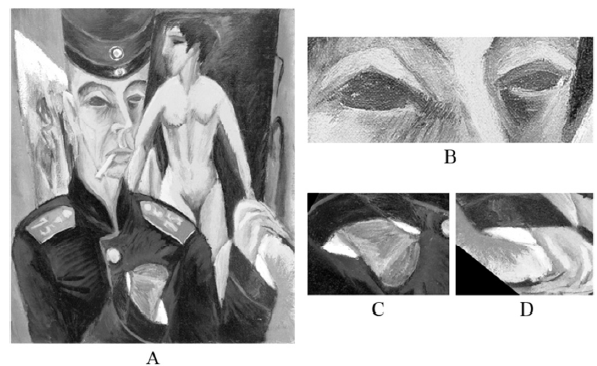
Ernst Ludwig Kirchner’s Self-portrait as a Soldier (1915) is a striking image of a German artist who, in his imagination, has lost his hand in the Great War. For some, the missing right hand, Kirchner’s brush-arm, symbolizes modern man’s “loss of control” and “the annulment of a tradition that identifies the artist with his creative tool [the hand].” What loss of control? Why break that tradition?
What few are likely to notice is that both sleeve openings are far too bright to be accurate and are, besides, eye-shaped. The stump of Kirchner’s arm protrudes from a white form which, rotated, is similar in shape to his “real” eye above. As to his other hand or, rather, his only hand, it floats above an armchair. The artist seems to be in front of a mirror (the surface we see) which means that his right hand, his brush-hand, is not missing after all. It is right there, “painting” the self-portrait. That’s why the fingers are pressed together as though they formed the brush itself.
The stump also recalls how our optic nerve links to the back of the eye, hinting that we see it from inside his head. Through the lower eyes, it is light outside; through the others, dark inside. Tradition maintained, the stump is vision, the hand craft, the two united.
Internet: <www.everypainterpaintshimself.com> (adapted).
- CCerto
- EErrado