Questão de Inglês — Verbos (Verbs) — CESPE / CEBRASPE 2025
- Código
- ce414366
- Banca
- CESPE / CEBRASPE
- Órgão
- UnB
- Ano
- 2025
- Cargo
- Vest ( )
The young Géricault became fascinated by the scandal around The Medusa. He had developed an interest in painting a macabre scene of murder or execution. This morbid appetite for the gruesome was perhaps not so unusual; many young men have it. But he needed something that would do more than send shivers down spines. He also wanted a theme that had weight and relevance to France herself. The ill fated raft of The Medusa, with its stark political backdrop, was a gift. Géricault was thorough. He devoured every scrap of information he could find on the disaster. In his studio, a dossier was filled to bursting with newspaper clippings beside the published accounts that he bought. He obtained heads, arms, legs and other off cuts of cadavers from a hospital for his research. Before long he had co-opted the help of those survivors of the raft who were in Paris.
Géricault talked to these men over and over again so as to have the closest possible understanding of what happened to them.
Then, realising the vast scale of the project he was about to commence, he took on a studio on the outskirts of Paris. Like many painters undertaking a formidable project, Géricault was keen to leave behind the world of distractions. In a gesture that had monastic echoes, he shaved his head. With a few exceptions, those who could help the painting along or model for its figures were the only people to pass through the studio doors. The immersion was complete. The serious work began.
Aengus Dewar. What They Don’t Tell You About Paintings: Théodore Géricault – The Raft of The Medusa. Internet: <www.aengusart.co.uk> (adapted).
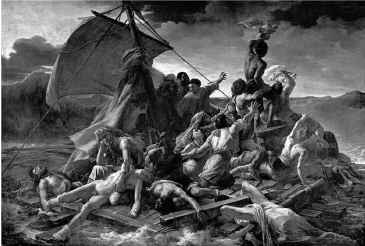
Un fait divers tragique
Géricault représente dans son tableau Le radeau de la Méduse un épisode du naufrage d’une frégate française, La Méduse, envoyée en juin 1816 pour coloniser le Sénégal. Escortée par trois navires, elle part avec deux cent quarante personnes à son bord.
Le capitaine, Hugues Duroy de Chaumareys, est un royaliste qui a émigré en Angleterre en 1791 et qui n’a pas navigué depuis vingt-cinq ans. Le 2 juillet, au large de la Mauritanie, son incompétence et son refus de suivre les mises en garde des jeunes officiers provoquent l’échouage du bateau, qui ne tarde pas à se briser et à prendre l’eau.
L’équipage se résout à abandonner le navire, Chaumareys monte à bord d’une des chaloupes et s’enfuit, tandis que, dans la confusion générale, cent cinquante-deux malchanceux prennent place sur un grand radeau. On leur laisse un peu d’eau, du vin, et on promet de revenir les chercher.
Treize jours s’écoulent avant d’être retrouvés. La faim, les noyades, les suicides et les affrontements violents ont raison de la plupart d’entre eux : seules dix personnes survivent à ce périple cauchemardesque.
Géricault, qui a 24 ans au moment des faits, entreprend son tableau un an et demi après le naufrage. C’est à son retour d’Italie qu’il souhaite se faire remarquer sur la scène artistique parisienne et décide de peindre pour le Salon de 1819 une oeuvre monumentale, apte à frapper les esprits.
Internet : <panoramadelart.com> (adapté).
Leia os textos.
The previous text is a passage from an essay on The Raft of The Medusa, a painting by Théodore Géricault inspired by a real event involving the French navy frigate The Medusa and its passengers in the summer of 1816. Considering the preceding text, judge item.
The use of the verb tense in the fragment “He had developed an interest” (in the second sentence of the text) is important to establish the context of Géricault’s choosing of the navy frigate’s story as a theme for his painting.
- CCerto
- EErrado