Questão de Inglês — Pronomes (Pronouns) — FUNDATEC 2025
- Código
- qa665738
- Banca
- FUNDATEC
- Órgão
- Pref Viamão
- Ano
- 2025
- Cargo
- Prof ( )
Reasons To Make A ‘Reverse Bucket List’, By A Psychologist
By Mark Travers
When you look back on your life, do you often experience regret, thinking of things you never did or goals you never accomplished? Many people experience a sense of shame, and even anxiety that they “should have been further along by now,” but these self-imposed timelines only harm us. Many of us create bucket lists, and perhaps you’ve already achieved some of the things on yours. And yet, you feel stuck — you compare yourself to a version of you that doesn’t exist, and this weighs on your relationship with yourself now. Interestingly, research shows that one of the most powerful ways to move forward is by taking a moment to look back, but with intention and compassion, rather than judgment.
In a two-part study published in the Journal of Happiness Studies, researchers found that people who regularly engage in “positive reminiscing” using vivid mental imagery report higher levels of happiness and a stronger capacity to savor meaningful moments. These individuals fared better than those who focused solely on the present or relied on physical memorabilia. This is the spirit behind creating a “reverse bucket list.” Instead of obsessing over what’s left to do, recalling positive memories and accomplishments from the past brings focus to all that we’ve already lived. It grounds us in gratitude, restores a sense of personal agency, and gently recalibrates our direction.
A 2022 study found that bucket lists are often shaped by an unconscious need to manage our fear of mortality; an urge to achieve more and leave behind a legacy. While this can be motivating, it can just as easily elicit anxiety and a constant sense of not being “enough.” However, a reverse bucket list turns your attention toward what’s already been meaningful in your life. For some people, an enriching experience was standing up for themselves when it was hard; for others, it was how they learned to be okay on their own. These moments don’t usually make it onto goal sheets, but they are, in many ways, the most defining, capturing the true evolution of your life.
Looking back also strengthens your identity. Your memories serve as a reminder of who you’ve been, what you’ve valued, and how you’ve grown. A 2013 study found that individuals who actively use their memories to reflect on their identity, strengthen social bonds, or guide future decisions report higher levels of purpose, positive relationships, and psychological wellbeing. The findings affirm that memory isn’t just a record of the past. It can be a tool for shaping how we see and relate to ourselves in the present. Writing down your reverse bucket list is a way of reinforcing your personal narrative: “I’ve handled hard things,” “I’ve lived through change,” “I’ve discovered what matters to me.”
It might feel very strange to look back in order to move forward, but when you revisit moments where you acted with courage, took initiative, or simply showed up for yourself, you are building the belief that you can do hard things again. A 2021 study published in the Journal of Consumer Affairs found that people who were asked to recall successful financial experiences felt more confident in their ability to manage money. That boost in belief didn’t just stay in their heads. It showed up in their behavior. They planned more, followed through better, and made more thoughtful decisions. The same holds true beyond finances.
When you remember what you’ve already faced and how you handled it, you remind yourself that you’ve got what it takes. And that kind of self-trust is the fuel for whatever comes next. Your past wins, regardless of how quiet or overlooked, aren’t just feel-good moments. They’re proof. A reverse bucket list helps you gather that proof, and bestows you with the power to move forward while also recognizing your past.
(Available at: https://www.forbes.com/sites/traversmark/2025/07/18/3-reasons-to-make-a-reverse-bucket-
list- by-a-psychologist – text specially adapted for this test.)
*Bucket list: a list of the things that a person would like to do or achieve before they die.
(Available at: https://dictionary.cambridge.org/us/dictionary/english/bucket-list)
In the cartoon below, we see two chickens sitting at a table with a crystal ball between them. Which alternative below correctly fills in the blank in the second chicken’s answer?
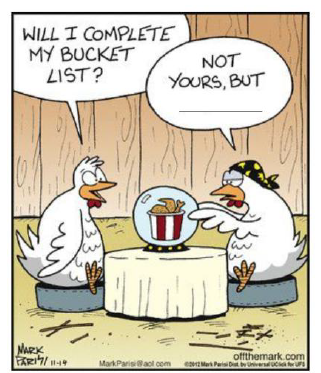
Fonte: Fat-Bottom Fifties Get Fierce
- Asomeones.
- Btheir.
- Csomebodies’.
- Dsomeone’s else.
- Esomebody’s.