Questão de Inglês — Interpretação de Textos (Understanding) — VUNESP 2026
- Código
- vu168686
- Banca
- VUNESP
- Órgão
- Humanitas
- Ano
- 2026
- Cargo
- Vest Med ( )
Leia o texto para responder à questão.
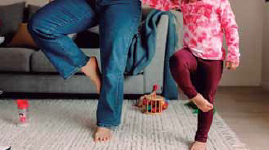
Unless you’re a flamingo, spending time delicately poised on one leg isn’t something you probably invest a lot of time in. And depending on your age, you might find it surprisingly difficult.
Balancing on one leg generally doesn’t take a lot of thought when we are young. Typically our ability to hold this pose matures by around the ages of nine to 10 years old. Our balance then peaks in our late 30s before declining.
If you’re over the age of 50, your ability to balance on a single leg for more than a few seconds can indicate a surprising amount about your general health and how well you’re ageing.
But there are also some good reasons why you might want to spend more time wobbling about on one pin¹ — it can bring a range of benefits to your body and brain, such as helping to reduce the risk of falls, building your strength and improving your memory. This deceptively simple exercise can have an outsized effect on your health as you age.
“If you find that it’s not easy, it’s time to start training your balance,” says Tracy Espiritu McKay, a rehabilitation medicine specialist for the American Academy of Physical Medicine and Rehabilitation.
(David Cox. www.bbc.com, 15.01.2026. Adaptado.)
¹ to wobble about on one pin: to balance on one leg.
- Aemphasizes the fact that balancing on one leg provides limited health gains for people who find the exercise easy.
- Baims to argument that balancing on one leg is beneficial, as it produces a strong impact on health.
- Cassociates balancing on one leg with physical health benefits, although not with cognitive performance.
- Dintends to show that balancing on one leg is engaging for children, although with no corresponding effect in adults.
- Eintends to illustrate how simple the exercise of balancing on one leg really is.