Questão de Inglês — Interpretação de Textos (Understanding) — VUNESP 2023
- Código
- vu183181
- Banca
- VUNESP
- Órgão
- SEDUC SP
- Ano
- 2023
- Cargo
- Prof EFM ( )
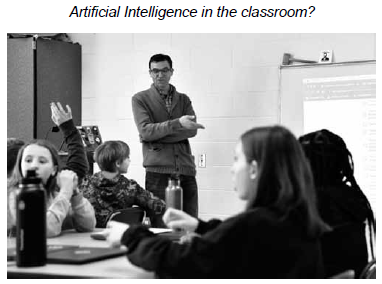
I recently asked Bard, Google’s conversational chatbot, whether artificial intelligence would replace teachers. Here’s what it said, “It is unlikely that AI will completely replace teachers in the near future.”
I agreed.
During a poetry night, I remember joking with a friend that it takes a broken heart to nurture and heal another heart. I added, “Until AI experiences heartbreaks, we must trust human teachers to nurture the hearts and minds of the next generation.” Yet it’s hard to ignore the growing questions and concerns emerging from the teaching community on the impact of AI on their jobs, their classrooms and their very vocation.
At the moment, AI still lags behind humans in complex tasks that require a combination of technical competencies and socio-emotional skills. However, and importantly, we must not give up all things cognitive to machines. Doing so would undermine critical thinking and reflection which are essential aspects of the human experience. We must continue to teach children how to think.
AI is forcing us to reimagine education as a vehicle for democratising thinking and knowing. There is no denying that. About 40% of the world’s population is under 24. If schools fail to prepare this generation of youth for the age of thinking machines, the consequences on social and economic peace may be dire.
As teachers, we must try and see how our classes will prepare students for technology and AI. On the surface, this requires reviewing curricula, syllabi and teacher professional development programmes, and incorporating content on AI literacy, risks, ethics and skills. At a deeper level, as machines become better at answering questions, educators should guide students to ask better questions. Today’s schools should inspire students to be curious as this is an essential ingredient to conducting primary research, including in frontier areas, where humans have an edge over AI.
When change becomes the only constant, we should not just help students to learn, we must inspire them to love lifelong learning.
(Momo Bertrand. https://www.aljazeera.com, 24.05.2023. Adaptado)
Leia o texto para responder à questão.
Releia o trecho a seguir, retirado do texto Artificial Intelligence in the classroom?, e leia o cartum.
As teachers, we must try and see how our classes will prepare students for technology and AI. […] as machines become better at answering questions, educators should guide students to ask better questions. Today’s schools should inspire students to be curious as this is an essential ingredient to conducting primary research, including in frontier areas, where humans have an edge over AI. (sexto parágrafo)

As palavras do jovem no cartum ilustram a seguinte necessidade para a relação entre AI e educação, apontada no trecho:
- Aa realização de pesquisas em temas relevantes pelos alunos.
- Bo oferecimento de melhores programas de formação tecnológica para professores.
- Ca educação para a curiosidade e o fazer perguntas.
- Da inclusão de variadas tecnologias nas salas de aula.
- Ea instrução para um melhor uso de computadores.