Questão de Inglês — Interpretação de Textos (Understanding) — VUNESP 2025
InglêsInterpretação de Textos (Understanding)
- Código
- vu217414
- Banca
- VUNESP
- Órgão
- UNIFIPA
- Ano
- 2025
- Cargo
- Vest Med ( )
Life Expectancy (1900-2023)
People are living longer. In 1900, the average life expectancy of a newborn was 32 years. By 2021 this had more than doubled to 71 years.
The large reduction in child mortality has played an important role in increasing life expectancy. But life expectancy has increased at all ages. Infants, children, adults, and the elderly are all less likely to die than in the past, and death is being delayed. This remarkable shift results from advances in medicine, public health, and living standards. Along with it, many predictions of the “limit” of life expectancy have been broken.
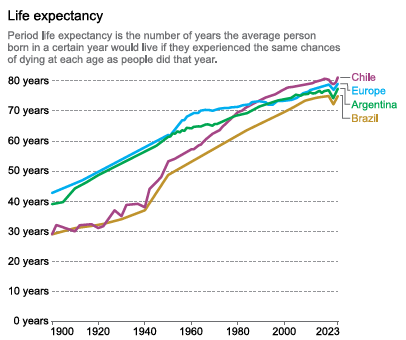
(Saloni Dattani et al. https://ourworldindata.org, 2023. Adaptado.)
Leia o texto e analise o gráfico para responder à questão abaixo. O trecho do texto que pode ser confirmado no gráfico é:
- A“In 1900, the average life expectancy of a newborn was 32 years” (1o parágrafo).
- B“This remarkable shift results from advances in medicine, public health, and living standards” (2o parágrafo).
- C“People are living longer” (1o parágrafo).
- D“The large reduction in child mortality has played an important role in increasing life expectancy” (2o parágrafo).
- E“Along with it, many predictions of the ‘limit’ of life expectancy have been broken” (2o parágrafo).